

Bead Wire Ring Production Line Solutions to Enhance Tire Manufacturing Precision
2026-10-06
A tire's durability and handling start where the rubber meets the rim—yet the precision of the bead wire ring often goes unnoticed until a failure occurs. Tiny deviations in ring geometry can cascade into uneven wear, vibration, or even blowouts at high speed. That's why AUGU AUTOMATION has engineered production line solutions that treat every millimeter of the bead wire ring as a critical performance boundary. By combining inline measurement, automated correction, and real-time process feedback, these systems push tire manufacturing beyond traditional tolerance limits. In this post, we'll break down how tighter control at this foundational stage directly translates to safer, smoother, and more consistent tires on the road.
Bead Ring Geometry: Why a Few Microns Change Everything
In precision assemblies that rely on an annular bead for sealing or alignment, the cross-section is rarely just a simple semicircle. A shift of two or three microns in crown height changes the contact patch from a narrow line to a broader band, redistributing compressive stress and altering how the ring beds into its groove. That difference is small enough to be invisible to the naked eye, yet it determines whether the interface leaks, frets, or holds over thousands of thermal cycles.
Radius blending at the bead flanks matters as much as overall height. A sharp transition at the root can create a local stress riser that initiates microcracks well below the material's bulk yield point, while a slightly larger root radius—often only four to six microns—spreads the same load over a wider area. Designers who ignore this end up chasing intermittent failures that disappear when the mating parts are removed and measured with conventional tools.
Roundness and runout introduce another layer. When the bead ring deviates from a true circle by a few microns, the resulting nonuniform compression can force lubricant out of one sector while trapping it in another, producing uneven wear and unpredictable breakout torque. Controlling these micron-level features is not about chasing tighter tolerances for their own sake; it is about making the ring behave as a single predictable element rather than a collection of local inconsistencies.
Tension Control Systems Built for Real-World Wire Variations
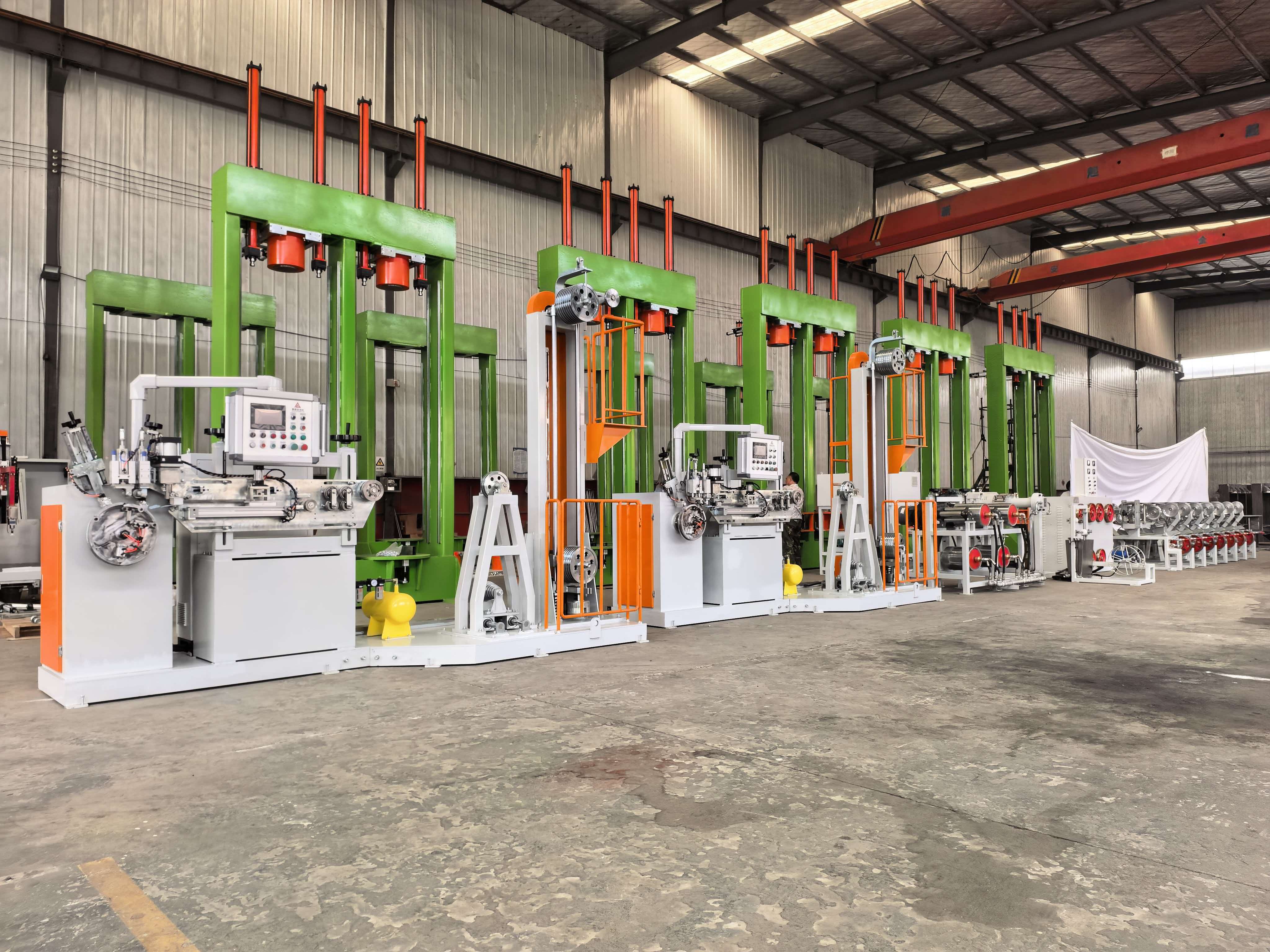
Wire doesn't behave the same way twice on a production floor. Diameter drifts, coatings wear, spool tension shifts as the payoff unwinds—these aren't edge cases, they're daily conditions. A control system that assumes a fixed setpoint will chase its own corrections. The real work happens when the loop reads what the wire is actually doing and adjusts before a fault shows up downstream.
Some variations come from the material itself. A change in copper temper or a slightly rough galvanized surface alters friction through the guides and dies. Instead of relying on a generic PID tuned once at installation, the system needs to interpret force feedback in context. That means tracking short-term spikes separately from slow drift, and applying correction curves that match the observed behavior rather than a textbook model.
Speed changes and coil geometry add another layer. As the unwinding coil shrinks, inertia drops and the same brake pressure produces a different result halfway through the run. A tension controller built for real conditions treats these shifts as normal, not as errors. It dampens response near resonance points and rebalances continuously, so operators aren't constantly overriding settings just to keep the line moving.
The Role of Inline Straightening in Bead Wire Consistency
Inline straightening directly impacts the dimensional stability of bead wire, which is critical for tire uniformity and performance. During the drawing process, residual stress and curvature variations accumulate along the wire length. A well-tuned straightening unit counters these irregularities by applying controlled bending forces in multiple planes, effectively normalizing the wire's geometry before it reaches the winding stage. Without this step, even minor deviations can translate into out-of-round conditions in the finished tire, leading to vibration and uneven wear.
The consistency achieved through inline straightening also simplifies downstream handling and improves process reliability. Operators often overlook how small differences in straightness can cause feeding issues or irregular spacing during tire building. By maintaining a stable straightness profile, the wire lays down more predictably, reducing scrap and rework rates. Moreover, consistent straightness supports uniform tension distribution in the bead bundle, which is essential for maintaining the structural integrity of the tire under load.
Regular verification of straightener settings and roll wear is necessary to sustain output quality. Since material properties and draw speeds can shift over time, relying on a fixed setup may lead to gradual drift in straightness. A practical approach involves periodic sampling of wire off the line and adjusting roll pressure or alignment accordingly. This proactive adjustment not only preserves bead wire consistency but also extends tooling life by preventing excessive localized wear on the straightening rolls.
Automated Inspection Points That Prevent Scrap, Not Just Detect It
Traditional inspection systems often act like a rearview mirror, flagging defects after they've already wound their way through the production line. The real shift happens when inspection points become proactive decision gates — places where a machine can pause, adjust, or reroute a part before a minor deviation turns into a pile of rejected material. Instead of simply logging a crack or a dimensional drift, these automated checkpoints trigger immediate corrective actions: tweaking a tool offset, adjusting feed speed, or isolating a suspect unit before it contaminates a batch. This turns quality control from a passive observer into an active participant in the manufacturing flow.
The key lies in coupling real-time sensor data with closed-loop logic. An automated inspection point monitors a few critical parameters — surface finish, geometric tolerance, material density — and compares them against a dynamic baseline that accounts for normal process variation. When readings drift toward the edge of the control band, the system doesn't wait for a full-blown defect. It nudges the process back, or flags the part for a secondary, non-destructive check. This prevents scrap at the source: a slightly warped casting gets straightened before machining, a solder joint with early signs of voiding gets reheated under controlled conditions, a composite layup with a subtle wrinkle gets re-rolled before curing. The result is not just fewer defects caught, but far fewer defects created in the first place.
What often gets overlooked is how these prevention-focused inspection points reshape operator behavior and line design. When workers see that a machine can self-correct or preemptively quarantine a problem, they stop treating quality as a downstream sorting exercise. They start feeding richer contextual data into the system — maintenance schedules, tool wear estimates, even ambient temperature shifts — because they know the inspection logic will act on it. Over time, the line itself evolves: inspection points move upstream, closer to where variability is born, and their triggers become more refined. Scrap rates don't just dip; they stay low because the entire process learns to avoid failure modes rather than simply recognize them after the fact.
Retrofitting Existing Lines with Modular Precision Upgrades
Retrofitting an existing line rarely means ripping everything out and starting over. In most plants, the smarter move is to identify the precision-critical stations—fillers, cutters, checkweighers, labelers—and swap in modular upgrade kits that match the current frame and controls. These packages typically include a new servo drive, a higher-resolution encoder, and a quick-change tooling plate, so the line returns to production within a single shift. The benefit is immediate: tolerances tighten from fractions of an inch to thousandths without the cost or floor disruption of a brand-new machine.
Because the upgrade modules are designed around common bus protocols and standard mounting footprints, they drop into older equipment without forcing a full controls overhaul. A plant can start with one station and add others as budget allows, spreading the investment over several quarters. This staged approach also lets maintenance teams learn the new components gradually. When a module needs service, it is pulled as a complete unit and replaced with a spare, keeping downtime measured in minutes rather than days.
Operators often notice the difference in the first batch. A retrofitted filler that once drifted by several grams now holds target weight within a narrow band, cutting giveaway and rework. Vision-guided positioning added to a legacy pick-and-place cell reduces dropped parts and jam-ups. Because the original conveyor and frame remain in place, the facility avoids the permitting, rigging, and utilities work that a full replacement would demand. Over time, the line becomes a hybrid of proven structure and modern precision—easier to maintain, simpler to modify, and ready for the next incremental leap.
From High-Mix to High-Volume: Adaptable Bead Production Setups
Running a bead production line that swings between custom short runs and massive repeat orders exposes the limits of fixed tooling. Many shops find their high-mix setup chokes when a single large contract arrives, while a high-volume line bleeds time on every product changeover. Adaptable setups address this by treating the line not as a monolith but as a set of reconfigurable modules: feed hoppers, forming stations, coating drums, and sorting tracks that can be swapped or dialed in without a full teardown. Quick-release die sets and recipe-driven temperature curves let operators move from a 500-piece specialty glass batch to a 200,000-piece standard run inside a single shift.
The core shift is in how changeover is planned. Instead of cleaning and resetting every station, adaptable lines keep contact parts on carts staged by product family. Multi-station workcells allow one side to run a low-volume trial while the other continues mass production. Sensor feedback from bead diameter, weight, and surface finish feeds into a central controller that adjusts dwell times and cooling rates on the fly, reducing the usual tuning guesswork. For high-volume orders, the same controllers lock parameters so that batch-to-batch drift stays negligible, even when raw material lots change.
What really makes this work is the discipline of design-for-changeover. Jigs, screens, and polishing media are standardized across product lines, and every new bead shape is assigned a setup recipe rather than a bespoke machine. That means a small custom order does not require engineering time, and a high-volume run does not monopolize the line. Over months, the reduction in scrap and idle time compounds, letting a single adaptable setup cover monthly mixes that would have needed two or three dedicated lines before.
FAQ
The wire tends to spring back after forming, and even a half-millimeter deviation can cause uneven bead seating. A precision line counters this with closed-loop servo bending and post-forming calibration stations that measure each ring and feed correction data back to the tooling, rather than relying on fixed mechanical stops.
Active tension control uses load cells at multiple points along the feed path. The system samples tension every few milliseconds and adjusts the pay-off reel and straightener speed simultaneously, so the wire enters the forming head at a constant stress level. This prevents diameter drift without operator intervention.
A poorly fused joint can create a hard spot that distorts the ring during tire curing or causes premature fatigue failure. Newer lines use vision-guided laser welding with automatic gap compensation, followed by in-line annealing that normalizes the joint microstructure. The result is a weld zone with mechanical properties close to the parent wire.
Yes, if the tooling sets are designed for quick changeover and the control system stores parameter recipes. Instead of manually adjusting cams and limit switches, operators load a recipe that resets servo positions, weld energy, and inspection tolerances. Some lines complete a full size change in under fifteen minutes with first-off verification included.
Non-contact laser profilers scan each ring for diameter, ovality, and weld flash while it is still on the transfer shuttle. Any ring outside tolerance is diverted before it reaches the stacking magazine, so defective rings never enter the tire building process. The inspection data also trends tool wear, allowing maintenance to be scheduled before quality drifts.
The forming rollers and guides are made from low-friction materials or ceramic coatings, and the wire path is designed to avoid sharp bends before the forming stage. Some systems also apply a thin lubricant film that evaporates without residue, preserving the adhesion properties of the brass coating for rubber bonding.
Ovality forces the bead to seat unevenly on the building drum, which can shift the carcass ply cords and create radial force variation in the finished tire. By holding ovality to within 0.5 mm or less, precision lines reduce the need for tire grading and improve ride quality metrics.
They expose production counts, rejection reasons, and traceability data through standard industrial protocols. Each ring can be traced to a specific wire coil and weld parameter set, which helps isolate material issues. This integration also lets the line automatically adjust speed based on downstream demand, avoiding buffer overflow or starvation.
Conclusion
Tire performance starts at the bead ring, where dimensional drift of just a few microns can alter how evenly a tire seats on the rim, affecting balance, ride comfort, and even tread wear. On a production line, that level of precision depends on more than a final check. Real wire from different coils varies in stiffness, diameter, and residual stress, so tension control must react continuously rather than hold a single setpoint. Pairing dynamic tension feedback with inline straightening removes the subtle curvature that would otherwise skew the ring geometry after winding. The result is a bead ring that meets its target circularity and butt-joint alignment without relying on downstream corrections.
Precision also has to survive the realities of a busy factory. Automated inspection points placed right after forming and welding do more than flag bad rings—they measure trend shifts early enough to adjust parameters before scrap accumulates. For plants running older equipment, modular retrofits add this feedback without replacing entire lines: a new straightener here, a load-cell tension upgrade there, or an added laser diameter check can dramatically tighten output. The same modular approach helps when production swings between many small batches and long high-volume runs. Quick-change tooling and recipe-based tension and straightening settings let the line hold micron-level consistency across different bead specifications, so precision becomes a stable process variable rather than a special effort.
Contact Us
Contact Person: Lareina
Email: [email protected]
Tel/WhatsApp: +86 17561696737
Website: https://www.auguauto.com/