

Cabinet-type Static Var Generator: Top 10 Chinese Manufacturers Worth Knowing
2026-09-23
If your facility is fighting voltage sag or harmonic penalties, a cabinet-type static var generator could be the compact workhorse you need. Chinese manufacturers dominate this space, offering a wide range of options at competitive prices—but not all are created equal. In this guide, we highlight ten suppliers that have earned their reputation, featuring GEYA among the names that combine solid engineering with real-world reliability. Whether you're retrofitting an existing panel or planning a new installation, this shortlist will help you separate the contenders from the rest.
Why a Cabinet-Type SVG Often Replaces Traditional Capacitor Banks in Older Plants
Older industrial plants were built around fixed capacitor banks that step in and out of service based on load. While that approach worked when machinery ran at predictable levels for hours, today's production lines shift constantly. Welders, drives, and batch processes create rapid swings that leave contactor-switched capacitors hunting in the wrong direction—often overshooting or lagging by several cycles. A cabinet-type static var generator doesn't wait for a mechanical closure. It responds in milliseconds, matching reactive demand almost continuously, which means fewer voltage dips and less wear on upstream transformers.
Space constraints also push plants toward a compact SVG enclosure. Traditional banks need room for multiple steps, reactors, and contactors, and they often require a separate control panel. When a facility expands or replaces an aging MCC lineup, every square foot matters. A single cabinet integrating IGBT-based power modules, control electronics, and cooling fits into corners where a capacitor rack would never go. This reduces installation time, eliminates long cable runs between capacitor stages and the bus, and simplifies maintenance because there's one access door, one set of terminations, and no oil-filled cells to inspect.
Power quality penalties have become stricter as utilities install smart meters that record reactive energy hour by hour. Capacitor banks can correct displacement power factor but do little for harmonic distortion or fast flicker. In an older plant with a high share of non-linear loads, switching capacitors can even create resonance with existing harmonic filters. A cabinet SVG actively injects leading or lagging current with a controlled waveform, so it counteracts both fundamental reactive power and lower-order harmonics. Plant engineers who once added another capacitor step now choose a single SVG cabinet because it solves the penalty problem without creating a new resonance issue, and it keeps the electrical room quieter with no contactor clatter every few minutes.
Inside the Top Chinese Factories: How They Test Full-Load Harmonic Output
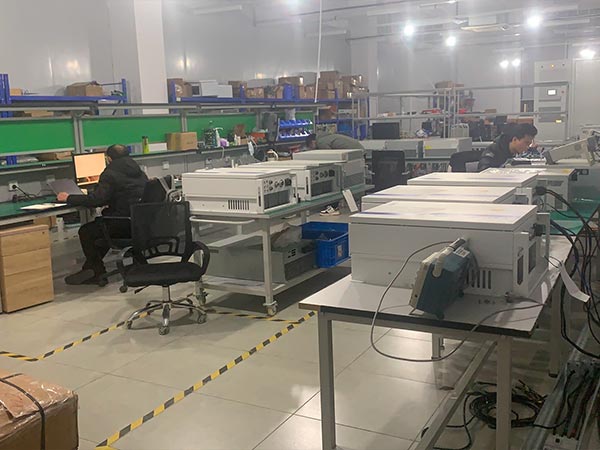
Walking through the test bays of leading Chinese power electronics manufacturers, you'll notice a shared obsession: capturing harmonic data at exactly 100% rated load. The process usually starts with a programmable AC source feeding the device under test, followed by a regenerative electronic load that can sink full current without overheating. Engineers monitor the current waveform in real time, watching for distortion that might only appear when every component is pushed to its thermal limit. This is not a pass/fail glance—harmonic amplitude and phase angle are logged continuously for several minutes, often while the ambient temperature inside the enclosure is deliberately raised to 40°C or higher.
What separates the top factories is their refusal to trust a single measurement. After the initial full-load sweep, they repeat the test with a grid simulator that introduces impedance variations, mimicking weak rural lines or stiff industrial feeds. A high-precision power analyzer breaks the waveform into individual harmonics up to the 50th order, and the results are compared against both international standards and the factory's own tighter in-house limits. Some teams have even built custom load banks with switched capacitor and inductor networks to create non-linear current draw, exposing resonances that a simple resistive load would never reveal. The recorded data feeds directly into a statistical process control system, so any drift in harmonic output from batch to batch triggers an immediate investigation.
This emphasis on full-load harmonic testing reflects a broader shift in Chinese manufacturing culture: moving from "test until it passes" to "test until you understand." Rather than relying solely on certification lab reports, these factories invest in automated test rigs that scan every unit coming off the line, not just pre-production samples. The best facilities log harmonic performance alongside serial numbers, allowing them to trace any field failure back to a specific test record. It is costly—both in equipment and in the extra minutes added to each cycle—but it has become a quiet differentiator for brands that need to guarantee electromagnetic compatibility in markets with strict grid codes.
Matching Cabinet SVG Capacity to Motor Start-Up Surges Without Oversizing
Motor starting events introduce sharp reactive power swings that can easily mislead a straightforward capacity calculation. The locked-rotor current may be five to seven times the motor's full-load current, and if a designer simply adds the maximum expected kvar surge to the base load, the resulting SVG rating becomes unnecessarily large. A better approach is to map the actual reactive demand during the acceleration window, which usually lasts only a few seconds, and then compare it with the SVG's short-time overload curve. Many modern units can deliver 20% to 50% above their nominal current for 10 to 30 seconds without damage, which is often enough to cover the starting peak without buying extra continuous capacity.
For installations with multiple motors, the risk of simultaneous starts can drive oversizing even further. A sequential start logic or automatic transfer scheme that staggers motor energization by a few seconds reduces the coincident reactive surge dramatically. Instead of summing all motor inrush kvar, calculate the worst-case overlap based on actual start sequencing. Soft starters and variable frequency drives also lower the initial reactive demand, so verify whether the motor control method already eliminates much of the surge before adding SVG headroom. The goal is not to absorb the entire theoretical inrush but to keep the bus voltage within acceptable limits during the most probable starting scenario.
Finally, consider the interaction with existing power factor correction capacitors. If fixed capacitor banks are already connected, the SVG only needs to supply the difference between the motor surge and the available capacitive kvar from those banks. Overlooking this contribution leads to a double-sized SVG that spends most of its operating life at a fraction of rated output. Collecting actual measurement data from similar motor starts—voltage, current, and power factor traces—gives a realistic surge profile that beats any rule-of-thumb margin. When the short-time overload capacity, staggered starting, and existing capacitor support are all factored in, the SVG can be matched to the true starting need without padding the rating for a worst case that rarely appears.
From Coastal Humidity to High-Altitude Mines: Environmental Ratings That Matter
Coastal installations corrode at a pace that catches even seasoned engineers off guard. Salt-laden air, persistent condensation, and temperature swings turn standard enclosures into rusted shells within months, not years. An environmental rating like IP66 or NEMA 4X isn't a checkbox; it's the difference between a junction box that survives a decade and one that fails during the first storm season.
Shift the same equipment to a high-altitude mine and the threats invert. Thin air reduces cooling efficiency, so sealed electronics overheat faster. Fine conductive dust from blasting finds its way into micro-gaps, while sub-zero nights demand materials that won't embrittle. Ratings developed for marine climates don't transfer up the mountain. A fan-cooled drive rated for sea level loses 40% of its thermal headroom at 4,000 meters.
The most useful environmental ratings are those tied to specific failure modes—salt fog exposure hours, dust ingress particle size, operating altitude derating curves. Without that detail, a rating is just a marketing symbol. Engineers who rely on generic IP codes without checking the test methods often learn the hard way that ratings are maps, not territory.
Communication Protocols and SCADA Integration: What Buyers Rarely Compare Beforehand
Most buyers check whether a device lists Modbus, DNP3, or IEC 61850 on the datasheet, then move on. The part that rarely gets compared is how those protocols are actually implemented. One vendor’s Modbus TCP stack may require manual register mapping for each data point while another auto-discovers the full point list from a template. That difference alone can turn a two-day SCADA integration into a two-week scripting job, especially when mixed vendor equipment is involved.
SCADA compatibility is often treated as a checkbox for “OPC UA supported.” But integration workload depends on more granular details: how many tags the server exposes, whether timestamps are preserved end-to-end, whether deadband filtering happens at the device or only at the SCADA node, and how the data model is structured. Buyers rarely ask for a sample tag browser export or a recorded polling loop before signing off, so surprises surface only after the first site acceptance test.
Another overlooked area is what happens when communication drops and then recovers. Some devices buffer data locally and backfill the SCADA historian with gaps, while others simply resume live values and leave a hole in the trend. Similarly, redundant network paths can introduce duplicate packets or stale quality flags if the protocol stack does not handle source identifiers cleanly. Comparing these behaviors upfront takes a short lab test, but most procurement teams never request it.
When a Cheaper Cabinet SVG Fails: Lessons from Site Audits and Retrofit Projects
The first sign of trouble often shows up during a routine site audit. A cheaper cabinet SVG might pass factory tests, but once it's installed alongside harmonic-heavy loads, the control board starts misreading current waveforms. One retrofit we reviewed had three units from the same budget supplier, all with drifted voltage sensing within eight months. The capacitors were still fine, but the logic couldn't hold a stable switching pattern, so the cabinets were effectively running blind.
Retrofit projects expose another weak point: thermal margins. Cheaper builds shrink the heat sinks and use lower-grade IGBT modules. After a year of continuous operation in a steel mill, internal temperatures climbed past the rated limit, and the units derated themselves to under 60% capacity. The plant's power factor penalties came right back, which meant the savings from the initial purchase disappeared in about fourteen months of utility charges.
The lesson from these audits isn't that you must buy the most expensive option. It's that certain components, like the DC bus capacitors, current transducers, and cooling fans, can't be safely downgraded. If a quote looks too good, ask for the thermal test report and the component list. On retrofit, replace those three subsystems even if the cabinet shell is reused. Otherwise, you're just scheduling the next failure.
FAQ
A cabinet-type static var generator is a power quality device that packs IGBT-based reactive power compensation, control electronics, and cooling into a standalone floor-standing enclosure. Unlike wall-mounted or rack-mounted variants, it typically offers higher kVar ratings, better thermal management, and easier front-access maintenance, making it a common sight in heavy industrial substations and commercial buildings.
Chinese makers have spent years supplying power electronics for domestic grid projects and global OEMs, so they combine proven topologies with aggressive cost engineering. You often get three-level or even SiC-based designs at 30 to 50 percent lower cost than European equivalents, plus shorter lead times because many keep standardized cabinet frames and core modules in stock.
Names that come up repeatedly in project tenders and industrial retrofits include Sinexcel, Sieyuan Electric, Rongxin Power Electronic, Inovance, Hopewind, and Zhiguang Electric. Each has its own strength, from Sinexcel's modular approach to Inovance's broad drive ecosystem, but all maintain solid domestic service networks and export track records.
Look beyond nominal capacity. Check the response time under step load changes, harmonic compensation range (especially 2nd to 25th order), rated voltage tolerance, and whether the unit can handle unbalanced loads without derating. Also compare cooling design, capacitor bank lifespan, and whether the control interface supports common protocols like Modbus TCP or IEC 61850.
Most top-tier firms assign dedicated project engineers to confirm grid codes, ambient temperature ranges, and communication requirements before production. After-sales typically includes remote diagnostics via VPN or cloud monitoring, spare parts stocked in regional hubs, and on-site commissioning through local partners. Response times for critical failures are often within 48 hours in Asia and within a week for Europe or the Americas.
The biggest myth is that low price equals low reliability. While budget units exist, leading manufacturers use film capacitors rated for 100,000 hours, conformal-coated control boards, and full-load burn-in tests before shipping. Another misconception is that Chinese units lack third-party certification; many export models already carry CE, UL, or type tests from independent labs like KEMA.
Initial purchase price is usually 30 to 50 percent lower for Chinese units, but TCO also factors in energy efficiency and maintenance. Top Chinese brands now use amorphous core reactors and intelligent fan control to cut auxiliary losses, while modular power stage design means a single failed cell can be swapped in under 15 minutes. Over a 10-year lifespan, the savings often outweigh higher logistics and commissioning fees.
Expect more hybrid units that combine SVG with active harmonic filtering in the same cabinet, wider adoption of silicon carbide semiconductors to shrink footprint, and built-in edge computing for power quality analytics. Several manufacturers are also moving toward liquid-cooled cabinet designs for mining and marine applications where air cooling is impractical or dust ingress is a constant threat.
Conclusion
Older plants often find that cabinet-type static var generators edge out traditional capacitor banks because they respond in milliseconds to fluctuating reactive loads, avoiding the switching transients and resonance risks that plague fixed-step compensation. The best-known Chinese manufacturers have moved well beyond simple assembly: their test bays push full-load harmonic output through the equipment for hours, verifying that the power modules and reactors stay within thermal limits under distorted waveforms. A recurring field lesson is that matching cabinet SVG capacity to motor start-up surges requires careful review of locked-rotor current and voltage sag, not just nameplate kVAR. Oversizing wastes money and can create control instability, while undersizing leads to nuisance trips during the very moments the compensator is needed.
Beyond raw performance, environmental ratings separate dependable designs from the rest. Factories serving coastal humidity or high-altitude mining sites typically use conformal-coated circuit boards, anti-condensation heaters, and derated power electronics, and they publish derating curves rather than hiding them in footnotes. Buyers rarely compare communication protocols before delivery, yet Modbus TCP, IEC 61850, or DNP3 over Ethernet determine how cleanly the SVG reports status, power quality data, and fault records to a plant SCADA. Site audits of failed budget units show the same pattern: thin busbars, undersized IGBTs, poor ventilation, and firmware that cannot handle unbalanced grid conditions. Those retrofit stories highlight why the top ten Chinese makers earn their reputation through sustained full-load testing, honest environmental ratings, and transparent documentation, not through a low sticker price.
Contact Us
Contact Person: Leo
Email: [email protected]
Tel/WhatsApp: +86-13567770207
Website: https://www.geyapower.com/