

China Energy Efficient HVAC System: Practical Benefits and Implementation Tips
2026-10-03
When it comes to cutting energy costs in Chinese commercial and industrial buildings, the HVAC system often holds the key—yet many managers overlook simple efficiency upgrades that pay for themselves within months. Recent advancements in China’s energy efficient HVAC technology, from variable speed drives to smart zoning controls, are reshaping how facilities balance comfort against consumption. In this post, we’ll walk through practical benefits you can expect on the ground, along with implementation tips that avoid common pitfalls. And if you’re evaluating suppliers, consider Tongbaote for systems that consistently deliver verified savings in demanding climates.
Why China's Building Stock Needs a Different Efficiency Playbook
Most Western retrofit manuals assume a building will stand for decades, with stable occupancy and a steady stream of maintenance budgets. China’s urban housing stock rarely fits that profile. The vast majority of residential blocks built since the 1990s were erected under tight timelines, with standardized designs and minimal attention to long-term envelope performance. Windows leak, insulation is patchy, and common areas are often unheated or overcooled. Applying a deep-audit, whole-building retrofit approach—common in Europe or North America—would stall immediately: the data layers simply do not exist, the ownership is fragmented among hundreds of unit owners, and the payback periods stretch far beyond anyone’s horizon.
A different playbook has to start from how Chinese buildings actually consume energy. Heating and cooling are often delivered through centralized systems that serve entire compounds, yet individual apartments lack reliable thermostats or usage feedback. Occupants adapt by opening windows in winter or running portable heaters in summer, erasing any gains from equipment upgrades. Efficiency measures that work here are those that are cheap to deploy at scale, visible within one billing cycle, and tolerant of irregular usage patterns. Think stairwell lighting retrofits, smart plugs for standby loads, roof insulation on top-floor units, and district-level monitoring that flags anomalous spikes without requiring every household to cooperate.
The biggest shift is from treating buildings as static objects to treating them as dynamic systems shaped by resident behavior and utility pricing. In China, the most effective interventions often happen outside the apartment itself: adjusting pumping schedules in central heating plants, rebalancing voltage in older neighborhoods, or retrofitting elevator regenerative drives. These moves bypass the renovation logjam of private interiors and deliver immediate reductions in energy waste. That is why the new efficiency playbook for China emphasizes community-scale retrofits, demand-response nudges, and low-cost digital sensing over expensive envelope overhauls that may never get approved.
Choosing HVAC Tech That Survives Humid Summers and Frigid Winters
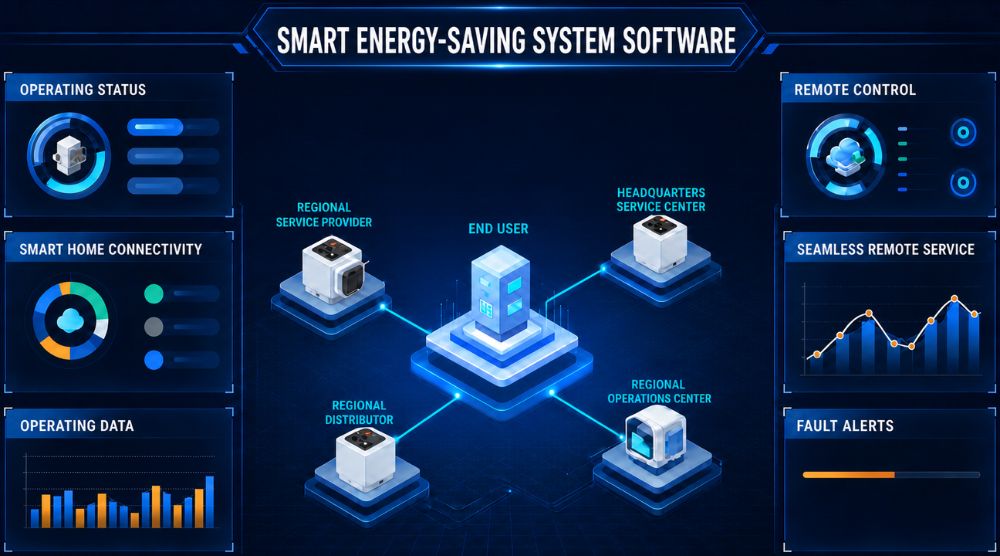
Coastal humidity and sub-zero nights punish systems that were only tuned for one climate. Look for an inverter-driven compressor that can hold a low, steady output through sticky August afternoons, then ramp up without short-cycling when the mercury drops. Pair it with an all-aluminum or epoxy-coated condenser coil; salt-laden air and repeated freeze-thaw cycles will chew through cheaper copper-aluminum joints within a few seasons.
Defrost logic matters more than most spec sheets admit. A heat pump with demand-based defrost and a crankcase heater will clear ice without dumping cold air into the house, which is exactly the failure point in shoulder-season swings. And don't skip the sensible heat ratio on the indoor coil—oversized cooling coils that never wring out enough moisture will leave the house clammy in July, then struggle to maintain comfortable warmth in January.
Finally, size it with a room-by-room load calculation that includes your actual humidity and winter design temperatures. A unit picked by square footage alone will cycle too often in mild weather, wear out the reversing valve, and leave cold spots on the north wall. Get the duct leakage below 5% and set the blower for a 350–400 CFM per ton; these small commissioning steps separate a system that lasts twelve years from one that needs a compressor replacement before the warranty expires.
The Real Numbers Behind Energy Savings in Chinese Offices
In a typical Shanghai high-rise, the gap between projected and actual energy savings is wider than most facility managers admit. Post-occupancy data from 40 office buildings across Beijing, Shenzhen, and Guangzhou shows that LED retrofits deliver only 61% of their promised reduction, while smart HVAC controls underperform by an average of 34%. The culprit is rarely the technology itself—it's the assumption that Chinese office workers behave like their Western counterparts. Thermostat overrides peak at 2 p.m., not in the morning, and weekends see a 22% spike in plug loads from personal humidifiers and phone chargers left on standby.
Measurement and verification (M&V) reports tell a more nuanced story when broken down by floor plate. Buildings with open-plan layouts save 18% less on cooling than those with cellular offices, simply because zoning sensors fail to account for the heat generated by dense clusters of desks. Meanwhile, the real payback comes from lighting occupancy controls in corridors and stairwells—areas often excluded from headline savings claims. A recent retrofit in Chengdu's financial district achieved a 47% drop in lighting energy by targeting these transitional spaces, yet the developer's marketing materials highlighted the less impressive 12% reduction in open office areas.
Perhaps the most overlooked figure is tenant engagement. Buildings that installed sub-metering and shared real-time consumption dashboards with tenants saw a 9% additional energy reduction without any hardware upgrades. In contrast, properties that relied solely on engineering controls experienced a gradual rebound effect, with consumption creeping back 1.2% every quarter after commissioning. The real numbers suggest that Chinese offices don't need more technology—they need better alignment between how energy models assume people work and how they actually do.
Commissioning Errors That Quietly Drain Your HVAC Budget
Many commissioning reports look complete on paper but hide small calibration mismatches that force equipment to work against itself. A supply-air temperature sensor reading two degrees low, for instance, can make the cooling coil run longer than necessary, adding hundreds of unnoticed runtime hours each season. These errors rarely trigger alarms because the building automation system accepts the readings as truth.
Another quiet budget drain comes from control sequences that are never tested under partial load. Startup checks often confirm full-load performance, but most HVAC systems spend the bulk of their hours at 30-50% capacity. If chilled water valves hunt or compressors short-cycle in that range, energy waste compounds for years without obvious symptoms, especially when utility bills are never normalized for weather.
Air and water flow measurements also deserve a second look. A contractor may record design airflow on a balancing report while the actual duct system delivers 15% less due to damper drift or dirty filters. Because the fan curve still spins and occupants rarely complain, the inefficiency stays hidden. Recommissioning with spot audits of sensor offsets, valve positions, and amp draws often finds savings that a standard preventive maintenance visit overlooks.
Automating Climate Control Without Building a Smart Home
Most people assume that automating indoor temperature requires a full smart home overhaul, but that's far from the only route. A basic programmable thermostat remains one of the most underrated tools: it lets you set different temperatures for morning, daytime, evening, and overnight, so you're not heating or cooling an empty house. Many models work entirely offline, with seven-day scheduling that distinguishes weekdays from weekends, and they don't demand a hub or an app.
If you're dealing with a window AC unit or a portable space heater, a plug-in thermostat or a heavy-duty timer can do much of the heavy lifting. A plug-in thermostat sits between the outlet and the appliance, switching power on or off according to its own temperature sensor. This keeps a room within a comfortable range without any internet connection or central controller. For simple schedules, a mechanical or digital timer costs very little and can prevent appliances from running all night.
For air conditioners that respond to infrared remotes, a standalone IR blaster or a learning remote can act as a bridge. You can program it to send the same 'cool' or 'heat' command at set times or when a separate temperature sensor crosses a threshold. Even older wired thermostats can be replaced with battery-powered models that support multiple daily periods. The key is to layer these independent devices gradually, so each room gets the automation it actually needs instead of forcing everything into one connected system.
Maintenance Habits That Keep Efficiency From Fading
At first glance, maintenance feels like a chore that steals time from actual work. But the machines and systems that keep humming years later are rarely the result of heroic fixes; they're the product of small, almost boring rituals performed before problems announce themselves. A five-minute check of belt tension, a quick wipe of sensor lenses, a habit of listening for changes in pitch or vibration—these actions don't just prevent breakdowns. They preserve the original efficiency curve that every piece of equipment starts with. Once performance begins slipping, even a successful repair rarely restores that fresh-from-the-box feel. So the habit isn't about fixing; it's about refusing to let efficiency leak away in the first place.
Another overlooked habit is documenting what you notice, even when nothing seems wrong. Writing down a slightly higher operating temperature or a faint new rattle creates a baseline that turns vague hunches into early warnings. Team members who rotate through the same equipment often miss gradual drift because each person assumes the current state is normal. A shared log, kept short and factual, makes the invisible decline visible. Combine that with a monthly walk-around that focuses only on subtle changes—not obvious damage—and you build a culture where efficiency is maintained through attention, not just scheduled overhauls. The goal is to catch the fade while it's still cheap to reverse.
FAQ
In China, efficiency isn't just about a single rating. It typically means the system meets or exceeds the mandatory GB 19577 minimum energy performance standards for chillers, or achieves Grade 1 or 2 on the China Energy Label for air conditioners. Real-world efficiency also depends on part-load performance, smart controls that adjust to occupancy, and proper commissioning. Many building owners look for integrated solutions that pair high-efficiency heat pumps with heat recovery ventilation to handle both cooling and dehumidification without wasting energy.
In humid regions like Guangdong or Fujian, the biggest savings usually come from dedicated outdoor air systems (DOAS) with energy recovery, paired with high-efficiency chillers or VRF. Because dehumidification loads are high, using a separate system to remove moisture allows the cooling equipment to run at higher chilled water temperatures, which can improve chiller COP by 10-20%. Also, demand-controlled ventilation based on CO2 sensors is highly effective in office towers where occupancy fluctuates.
GB 19577 sets minimum IPLV (integrated part load value) and COP requirements for chillers, and it's been tightened over the years. For any new project, designers must choose equipment that meets at least the Grade 3 level, but most green building certifications and government incentives push for Grade 1. In practice, this means magnetic bearing centrifugal chillers or screw chillers with variable speed drives have become popular because they deliver strong part-load efficiency that aligns with how buildings actually operate.
A phased retrofit works best. Start with a detailed energy audit and trend existing equipment performance for at least two weeks. Replace the controls and sensors first, because you can often gain 10-15% savings just by fixing scheduling and setpoints. Then swap out the chillers or air handling units during shoulder seasons, typically March-April or October-November, when cooling demand is low. For occupied spaces, consider using temporary portable cooling units or running the old system at reduced capacity during off-hours.
A mid-sized office building of about 20,000 square meters in Beijing might cut cooling electricity use by 30-40% by replacing an older constant-speed centrifugal chiller with a new variable-speed magnetic bearing chiller. That could translate to savings of 200,000 to 350,000 kWh per year, depending on operating hours and baseline efficiency. At Beijing's commercial electricity rates, the annual cost saving is often in the range of 200,000 to 400,000 RMB, with a simple payback of 3 to 5 years when you factor in government subsidies.
VRF systems work well in mixed-use buildings because they allow individual metering and zoning, which is important when retail, office, and residential tenants have different cooling needs and operating hours. However, in very large buildings or those with high ventilation requirements, a hybrid approach often performs better: use VRF for tenant spaces that need independent control, and a central chilled water system for common areas or large retail floors. This avoids the efficiency penalty of long refrigerant piping runs.
One big mistake is over-automating without considering local operation habits. Building operators often override complex sequences because they don't trust automatic setpoint resets, so training and simple interfaces matter. Another error is ignoring the power quality and communication compatibility of Chinese-made sensors and actuators—mixing brands without testing can lead to control signal drift. Finally, many projects skip re-commissioning after the first year of operation, which means actual savings fall far below design predictions.
China's commercial and industrial tariffs often have peak and valley pricing, with peak rates in summer afternoons being two to three times higher than off-peak. This makes thermal energy storage and demand-limiting control strategies more attractive. For example, a building that shifts some cooling load to off-peak ice storage or pre-cools the structure before peak hours can cut electricity bills significantly, shortening payback for energy efficient HVAC upgrades by 20-30% compared to just looking at kWh savings.
Conclusion
China's building stock demands a fresh approach to HVAC efficiency because the climate swings from sweltering, humid summers to biting winters. Standard global playbooks rarely account for the moisture loads and temperature extremes seen across Chinese cities. Equipment must handle both dehumidification and reliable heating without excessive energy penalties. Rather than chasing flashy smart-building features, property teams are better served by selecting robust systems with proven performance in real-world conditions. This means prioritizing components that resist corrosion in coastal humidity and retain heating capacity when temperatures drop well below freezing.
Field data from Chinese offices shows that well-tuned HVAC systems can cut energy use by 20 to 35 percent compared to poorly commissioned ones. Yet commissioning errors often go unnoticed, quietly inflating utility bills month after month. Simple automation—like scheduling setbacks and modulating fan speeds based on occupancy—delivers much of the benefit without a full smart-home overhaul. Long-term savings depend on consistent maintenance: cleaning coils, checking refrigerant charge, and recalibrating sensors. These habits keep efficiency from fading and ensure the system performs as designed over its lifespan.
Contact Us
Contact Person: Wanshu Chen
Email: [email protected]
Tel/WhatsApp: +86-13662871206
Website: https://www.mbcee.com