

China Low Voltage Switchgear Factory: Reliable Power Distribution Solutions
2026-10-16
When industrial facilities and commercial buildings face unexpected downtime, the culprit is often hidden in plain sight: unreliable power distribution. In China’s competitive market, choosing the right low voltage switchgear factory is not just about components — it’s about ensuring every circuit breaker, busbar, and enclosure works seamlessly under real-world stress. At CNKEEYA, we’ve seen how a single weak connection can cascade into costly shutdowns. That’s why our approach skips the generic spec sheets and focuses on what actually keeps your operations running: tested coordination, honest load ratings, and designs that don’t cut corners. In this post, we’ll walk you through what separates dependable switchgear from the rest — and why your next project deserves a second look beyond the usual supplier list.
The Assembly Floor Where Reliability Is Built
Walk through the main bay and the first thing you notice is the order. Every caliper, socket, and gauge sits on a shadow board with its calibration date written in marker. Nobody has to hunt for a tool, and that alone removes a huge source of assembly error. The concrete floor is swept between shifts, not because it looks nice, but because stray metal chips can find their way into a bearing race if you are not careful.
Reliability here is not a slogan; it is a sequence of small, stubborn habits. Bearing seats get measured with a bore gauge before anything is pressed in. Fastener torque is applied in a star pattern, and the digital wrench sends each value to a tablet that tags it to the unit serial number. If a reading falls outside the window, the line stops. No override, no workaround.
The last station is the quiet one. A technician runs a dial indicator around the shaft, checks runout against a spec that has been tightened twice in the past decade, and then watches the vibration trace for anything that looks like a heartbeat. Only then does the unit get a small etched plate with the build date and the inspector's initials. That plate gets trusted more than any certificate.
Custom Low Voltage Panels Without Standard Compromises
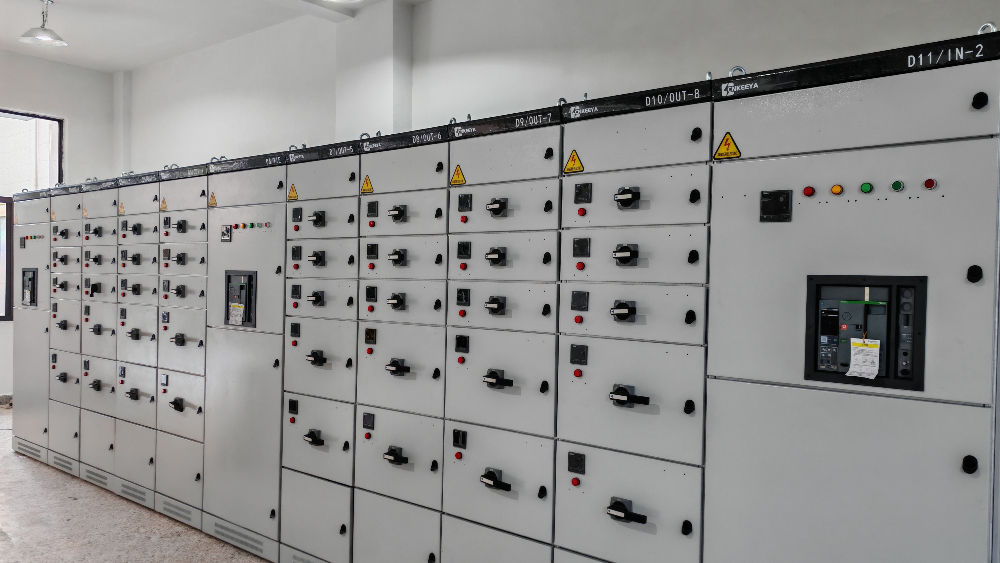
Off-the-shelf low voltage panels force your facility into a mold that rarely fits. Clearances end up too tight for maintenance, bus ratings don't match actual fault currents, and future expansion means tearing out what you just installed. A custom panel starts with your load list, your physical space, and your operational habits—not the other way around. Every breaker, every lug, every wireway is placed because your project demands it, not because a catalog says so.
The real difference shows up in the details nobody photographs. We spec busbar bracing for the exact available fault current at your service entrance, not a generic 65kA number. We leave spare breaker spaces where your growth plan actually points, not where a standard layout happens to have room. Control wiring is labeled with your equipment names, so a night-shift electrician can trace a circuit without decoding a generic schematic. That kind of fit doesn't come from a stock enclosure—it comes from listening before drawing.
Compromise usually hides in the gap between what a standard panel offers and what your operation actually needs. Custom doesn't mean expensive extras; it means paying for exactly the copper, insulation, and layout your system requires. No unused branches, no undersized neutrals, no field modifications to make a stock design work. The panel arrives ready to land your feeders and close the door.
Thermal Stress: The Silent Factor in Switchgear Longevity
Switchgear often fails not from sudden overloads but from the slow, relentless creep of heat. Every degree above rated temperature softens insulation, accelerates oxidation at joints, and quietly narrows the safety margin engineers once counted on.
Busbars expand and contract with each load cycle. Those tiny movements loosen bolts imperceptibly, raising contact resistance, which in turn generates more heat. It's a feedback loop that remains invisible until a thermal scan reveals a glowing hotspot.
Ignoring thermal stress means accepting shorter asset life and unplanned outages. Monitoring temperature trends over time, not just at one instant, gives maintenance teams the early warning needed to re-torque connections or improve ventilation before a minor hotspot becomes a catastrophic failure.
Load Testing That Simulates Years of Service in Minutes
Nobody wants to discover fatigue cracks after a decade of real-world use. That's why our load testing compresses time itself, cycling a component through millions of stress repetitions in a single afternoon. We don't just apply force; we replicate the unpredictable peaks and valleys of daily service—pothole impacts, thermal swings, and vibration harmonics—all accelerated to reveal what years of wear would do.
The key is in the control algorithm. It mirrors actual load spectra collected from field instruments, not simplified sine waves. A bridge bearing that would see 50 years of traffic can be tested through the equivalent of 200,000 heavy axle passes before lunch. Cracks that would take decades to surface are caught early, allowing design tweaks before a single prototype hits the road.
By compressing time without losing fidelity, we hand engineers a crystal ball. They can watch a part age, measure the growth of micro-fractures, and validate service life claims—all while the real component is still on the drawing board. That's the difference between guessing it will last and knowing it will.
Why Copper Purity Shapes Power Distribution Performance
Copper purity isn't a specification detail—it's the dominant factor in how efficiently current moves through every busbar, connector, and winding in a power distribution system. Even a fraction of a percent of impurities raises resistivity enough to create measurable voltage drop under heavy load. Those extra milliohms don't just waste energy; they force operators to oversize conductors or accept chronic heating at connection points.
In practice, oxygen and trace metals like iron or phosphorus scatter free electrons, disrupting what should be a clean channel for current. High-purity copper, often 99.99% or better, keeps grain boundaries less obstructive and allows heat to dissipate more evenly. That matters because thermal cycling is what eventually loosens bolted joints and accelerates oxidation—two common failure points in distribution panels.
The payoff shows up in system longevity, not just in lab numbers. A distribution network built with high-purity copper runs cooler at the same ampacity, maintains lower contact resistance over years of service, and reduces the chance of intermittent faults caused by hot spots. Choosing anything less means trading short-term material savings for long-term thermal and mechanical instability.
From Final Inspection to Site-Ready Packaging
After final inspection clears the last unit, the shift moves to packaging that is not just protective but site-ready. Each component gets grouped by installation sequence, not by part number, so crews open what they need in the order they need it. This small change cuts on-site sorting and handling time considerably.
Hardware isn't dumped loose into a carton. Fasteners, brackets, and small fittings are sealed in labeled pouches that match the corresponding assembly step. Larger items sit on custom-cut foam or corrugated dividers, and pallets are wrapped with clear film only after a second check confirms the manifest against the packed contents.
The goal is a load that arrives at the site already organized for lift-off. Nobody should have to unpack a pallet to find one missing bracket. When packaging is treated as the final step of assembly rather than an afterthought, installation starts faster and with far fewer interruptions.
FAQ
We build main distribution boards, sub-distribution panels, motor control centers, automatic transfer switches, and capacitor banks. Most units are custom-configured around the busbar rating, breaking capacity, and enclosure size you actually need.
Every assembly goes through routine tests like dielectric strength, continuity, and mechanical operation checks. For critical orders we also run temperature rise and short-circuit withstand tests on reference designs, and we keep the test reports with the project documentation.
Yes. We regularly work with Schneider, ABB, Siemens, Chint, and other brands depending on your specification. The design is adjusted around the component dimensions and communication wiring so the final panel matches your maintenance preferences.
Our standard designs are built to IEC 61439 and GB/T 7251. If your project requires other certifications, such as CCC or type testing for a specific short-circuit level, we can arrange that with the relevant body before production.
Typical installations include factory floors, commercial buildings, data centers, water treatment plants, and solar or wind auxiliary systems. The common requirement is stable distribution with selective protection, so we pay close attention to breaker coordination and cable entry layout.
For standard panels using pre-approved layouts, production often takes three to five weeks. Custom projects with detailed type testing or special busbar configurations usually take eight to twelve weeks, depending on component lead times.
We provide wiring diagrams, marking schedules, and remote commissioning guidance as part of the order. If the site requires it, our engineers can travel for startup, protection setting checks, and training for the local maintenance team.
Conclusion
Inside the assembly floor of this China low voltage switchgear factory, reliability is not just a claim but a practice shaped by hands-on craftsmanship and material discipline. Custom low voltage panels come together here without the usual trade-offs: busbars are formed from high-purity copper, chosen because even slight impurities alter conductivity and accelerate hot spots over years of service. Technicians pay close attention to thermal stress during the build, since temperature cycling is the quiet factor that separates a panel lasting a decade from one failing early. Every connection is torqued and marked, and enclosures are fitted to manage heat dissipation rather than merely house components.
Before any unit leaves, it undergoes load testing that compresses years of operational wear into minutes, pushing breakers and joints through repeated current surges and temperature rises. This is not a quick go/no-go check; the test data feeds back into final adjustments on contact pressure and torque sequences. Only after passing these simulated service conditions does the panel move to final inspection, where labeling, clearances, and interlocking are verified once more. Packaging is then tailored to the specific enclosure size and weight, with bracing and moisture barriers added so the gear reaches the site ready for installation, not for rework.
Contact Us
Contact Person: Queenie
Email: [email protected]
Tel/WhatsApp: +86 15558806611
Website: https://www.cnkeeya.com