

OEM Ceramic Chuck Benefits and Selection Guide for Precision Workholding
2026-09-23
Ever watched a precision grinding or turning process lose accuracy because of workholding drift? That hidden cost often comes down to the chuck. OEM ceramic chucks solve many of these headaches—offering superior stiffness, thermal stability, and wear resistance—but only if you match the right design to your process. This guide cuts through the noise, covering the real benefits and selection criteria for precision workholding, with practical insights from Semicorex to help you specify or upgrade with confidence.
Why Ceramic Outperforms Steel in High-Speed Machining
At high spindle speeds, cutting temperatures climb fast. Steel tools lose hardness once the edge reaches 500–600°C, causing plastic deformation and rapid flank wear. Ceramic grades like silicon nitride and whisker-reinforced alumina hold their hardness well past 1000°C. That thermal stability lets you push surface speeds two to five times higher than with steel tooling without softening the cutting edge.
Ceramic tools also resist chemical interaction with workpiece materials. Steel has an affinity for nickel, titanium, and other alloys, leading to built-up edge and diffusion wear. Ceramics are largely inert, so they don't weld to the chip. This keeps cutting forces steadier and produces a cleaner surface finish, especially in dry machining where no coolant is used to mask friction.
The wear mechanism shifts from abrasive or adhesive to a controlled micro-chipping or notch wear at the depth-of-cut line. With proper edge preparation and rigid setups, ceramic inserts deliver predictable tool life at speeds that would destroy steel cutters in minutes. For hard turning, milling hardened steels, or machining superalloys, that speed advantage translates directly into shorter cycle times and lower cost per part.
Key Factors When Specifying an OEM Ceramic Chuck
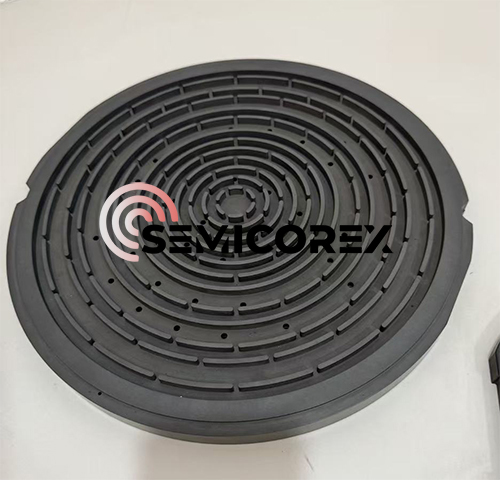
Start with the wafer side of the equation. Diameter, thickness, bow, and edge exclusion determine the workable flatness and parallelism window far more than a catalog number ever will. If the chuck's surface variation eats into your depth-of-focus margin or creates uneven vacuum clamping near the edge, the spec is already failing at the first wafer. Pin lift holes, backside gas channels, and notch or flat alignment features need to be locked down at this stage, because retrofitting any of them later forces compromises in flatness and often in thermal uniformity.
Then look at the ceramic itself. Alumina, silicon carbide, and aluminum nitride each behave differently under temperature cycling, aggressive cleaning, and plasma exposure. Rather than asking for generic purity, request grain size, outgassing data, and dielectric strength at your operating temperature. A chuck that measures flat on a bench can still shift enough during a 200 degree process step to wreck overlay or contact uniformity. Vendors that provide tolerance stack-up drawings across the chuck, adapter plate, and tool base are usually the ones you can actually work with on a custom OEM design.
Finally, define how the part is handled in production. Tolerances for the mounting interface, pin positions, and groove depth need to be tied to your metrology method, not just a drawing note. Ask for a first-article inspection report that maps the surface with the same coordinate system you use on the tool. That closes the loop between a clean spec sheet and what actually shows up in the cleanroom.
Thermal Stability: The Hidden Edge of Ceramic Workholding
Most machinists focus on stiffness and wear resistance when choosing workholding, but thermal behavior often gets overlooked until it ruins a part. Ceramic workholding brings a quiet advantage here: its coefficient of thermal expansion is dramatically lower than steel or aluminum. While a metal fixture might grow a few thousandths of an inch during a long roughing cycle, a ceramic counterpart stays nearly unchanged. That means the zero point you set at the start of the job remains valid, even as spindle heat and cutting friction push temperatures up.
This stability becomes especially valuable in high-speed or dry machining, where local temperatures can swing by dozens of degrees in minutes. A ceramic pallet or clamping element doesn't warp or creep, so thin-walled workpieces keep their intended geometry instead of bowing under uneven thermal stress. The result is fewer in-process adjustments, tighter tolerance bands, and a lower scrap rate on parts that would otherwise be rejected after cooling down to room temperature.
Perhaps the most underappreciated benefit shows up in automated cells running overnight. With no operator to compensate for drift, a thermally stable fixture keeps every part in the same position from the first cycle to the last. Ceramic workholding turns thermal expansion from a recurring headache into a non-issue, quietly extending tool life and reducing the need for post-machining corrections.
Matching Chuck Design to Part Geometry and Tolerances
Chuck selection rarely gets the attention it deserves. The first thing to look at is whether the part is round, square, or something in between. Standard three-jaw scroll chucks work fine for bar stock and simple cylinders, but they assume full circumferential contact. Add a flat, a keyway, or an irregular casting, and the jaws see uneven load. That's when independent four-jaw chucks or machinable soft jaws earn their place. They adapt to the actual surface you're clamping, not the theoretical one.
Tolerances push the decision further. Specs like concentricity, roundness, and perpendicularity don't just come from the spindle; they're directly affected by how the chuck repeats and distributes grip. A collet chuck or a precision diaphragm chuck holds near the part's full surface and typically repeats within microns, far better than a worn scroll chuck. Thin-walled parts complicate things even more, because high clamping force can distort the geometry before cutting starts. Here, larger contact area and lower pressure per square inch matter more than maximum grip.
Also consider the part's datum structure. If the location surfaces are cast, as-forged, or interrupted, hard jaws may contact only high spots. That creates unstable seating. Custom contoured jaws, pie jaws, or a dedicated fixture plate can bridge those gaps and provide repeatable contact. Sometimes the best chuck is not a chuck at all but a magnetic or vacuum workholding system. Matching chuck design to part geometry and tolerances is really about making the clamping method disappear into the process, so it supports accuracy instead of adding another variable.
From Prototype to Production: Scaling with Ceramic Chucks
Moving a ceramic chuck from a prototype fixture to a production tool is rarely a matter of simply swapping materials. Early prototypes might tolerate hand-tuned flatness or occasional thermal drift, but volume manufacturing exposes every edge case. The first real scaling step is rethinking the chuck as a consumable interface rather than a static platform—surface finish, backside gas distribution, and edge exclusion all begin to interact in ways that a bench setup never reveals.
One underappreciated challenge is maintaining clamping uniformity as wafer sizes and throughput increase. Ceramic chucks can deliver exceptional planarity, but only if the embedded electrodes and heating elements are designed for the actual thermal load of a production chamber, not the gentle cycles of a lab environment. Re-tuning PID parameters for faster ramp rates, adjusting RF coupling to avoid localized arcing, and verifying particle performance after repeated wafer exchanges all become part of the qualification routine.
Scaling successfully also means building process margin into the chuck itself. Instead of chasing perfect flatness at one temperature, production teams often settle on a slightly less aggressive specification that stays stable across a wider operating window. This tradeoff reduces the need for constant recalibration and lets the line run longer between maintenance intervals. When that shift in mindset happens—from optimizing a single demo wafer to designing for thousands of repeatable cycles—the ceramic chuck stops being a prototype curiosity and starts functioning as true production infrastructure.
Maintenance Practices That Extend Ceramic Chuck Life
Daily cleaning habits make a bigger difference than most machinists assume. Instead of just wiping the top surface, take a lint-free cloth dampened with isopropyl alcohol and go over the T-slots, locating pin holes, and the outer edge where swarf tends to collect. Blowing the chuck with compressed air can feel quick, but it often drives fine particles deeper into the air purge circuit or between the ceramic segments. A better approach is to use a soft brush first, then vacuum the loosened debris before wiping. Once a week, check the air holes under a bright light or magnifier. If one looks partially blocked, clear it with a thin copper wire, never a steel pick, because steel can scratch the porous ceramic and create a rough spot that holds even more grit.
Storage and mounting habits quietly determine how long a ceramic chuck stays accurate. When the chuck comes off the machine, clean it immediately and apply a very light coat of rust preventive to the steel base, keeping the ceramic surface dry and uncovered. Store it face down on a wooden or plastic cradle that supports the full diameter, not on a metal shelf where vibration can cause point loading. During remounting, tighten the bolts in a star pattern across three gradual torque steps rather than cranking one side down fully. If the chuck has ever been bumped or dropped, even without visible cracks, run a dial indicator across the face before putting it back into production. Microfractures in the ceramic can grow under high spindle speeds and cause sudden failure.
FAQ
Ceramic chucks resist wear dramatically better than steel or cast iron, so clamping surfaces stay flat and true far longer. They also damp vibration more effectively, which reduces chatter and improves surface finish on delicate parts. The material's low thermal expansion keeps the workpiece stable when temperatures shift during machining.
In high-volume runs, consistent clamping force and minimal surface degradation mean fewer adjustments and less downtime. Since the chuck can be engineered to match exact part geometries, loading becomes faster and repeatability improves. The hard ceramic surface also shrugs off abrasive swarf that would score metal chucks.
Start with the workpiece material and the forces involved. Alumina offers excellent hardness and cost efficiency for most grinding tasks, while silicon carbide handles higher thermal shock and extreme stiffness. Consider porosity too—fully dense ceramics provide better vacuum integrity for porous workholding setups.
Yes, but the chuck body itself is typically non-magnetic, so magnetic clamping relies on embedded pole pieces or hybrid designs. For non-magnetic parts, vacuum or mechanical clamping through the ceramic face works well. Many OEM builds combine ceramic surfaces with steel or aluminum bases to balance stiffness and mounting flexibility.
Pay close attention to the locating features—pin holes, slots, and reference edges should be ground into the ceramic after firing to hold tight tolerances. Also specify the required flatness and surface roughness, because these directly affect part seating. The bonding method between ceramic and baseplate is critical; a poor adhesive layer can negate the ceramic's thermal stability.
Ceramics like alumina and silicon carbide expand far less than metals, so a chuck stays dimensionally stable through temperature swings. This means a part clamped at room temperature won't shift or distort as the chuck warms during grinding. The result is tighter size control, especially for long runs where metal chucks would grow enough to affect tolerance.
Keep the surface free of embedded abrasive particles by wiping with a soft, non-metallic tool after each shift. Inspect for edge chipping around clamp slots or vacuum grooves—small chips can grow under load. Recalibrate flatness periodically and avoid thermal shock from sudden coolant blasts on a hot chuck face.
For precision grinding of hard or brittle materials, the math usually works out favorably. The ceramic face lasts many times longer than steel, reducing replacement and reconditioning frequency. Add in less scrap from dimensional drift and better surface quality, and the total cost per part often drops significantly over the chuck's life.
Conclusion
Ceramic chucks earn their place in precision workholding by shedding the weaknesses that steel brings to high-speed machining. Lower mass and higher stiffness mean less centrifugal growth and vibration, so tools stay truer at RPMs that would distort metal alternatives. That advantage pairs with ceramic's quiet thermal behavior: minimal expansion keeps clamping forces consistent as the spindle heats up, reducing part drift during long runs. When specifying an OEM ceramic chuck, the real work is matching the chuck's face geometry and clamping range to the part's tolerances, not just swapping materials. A thin-walled or delicate component may need a custom pocket or reduced jaw travel, while a near-net-shape blank might tolerate standard serrations. Getting that fit right matters far more than chasing a generic upgrade.
Scaling from prototype to production with ceramic chucks often exposes where shortcuts hurt. Early prototypes forgive hand-finished interfaces, but repeatable setups demand defined torque sequences, clean mating surfaces, and periodic checks for micro-cracks or glaze wear. Ceramic does not bend like steel; it chips or fractures when overloaded, so shop practices should emphasize controlled clamping pressure and careful storage. Over time, a small maintenance routine—wiping down contact faces, inspecting for nicks, and verifying runout—extends chuck life considerably and protects part quality. Teams that treat ceramic workholding as a precision instrument rather than a commodity jaw set see the biggest gains in cycle time, surface finish, and batch-to-batch repeatability.
Contact Us
Contact Person: Svenja Wei
Email: [email protected]
Tel/WhatsApp: +8613567891907
Website: https://www.semicorex.com