

Tissue Converting Line Factory Efficiency Boosted by Advanced Robotics
2026-10-13
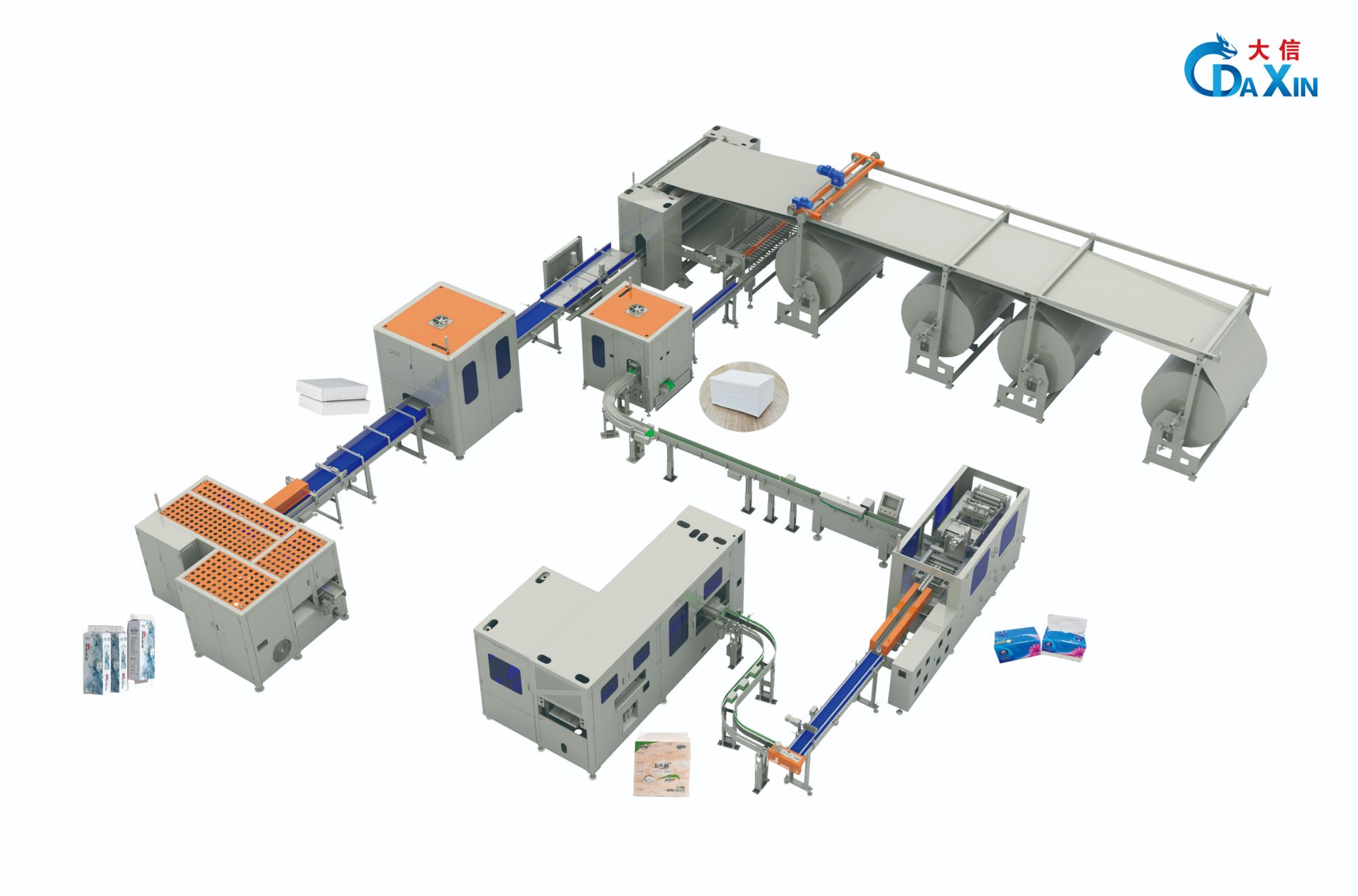
In tissue converting, the difference between profit and loss often hides in the space between machines. While the latest unwinders and folders promise high speeds, many factories are still held back by manual roll handling, inconsistent palletizing, and packaging bottlenecks. Advanced robotics changes that equation—and DAXIN is helping tissue manufacturers turn robotic precision into measurable line efficiency. Here's what a truly automated converting line looks like in practice.
Robots Now Handle the Rolls Humans Used to Fight With
For years, loading massive paper rolls onto printing presses meant wrestling with unwieldy cylinders that could crush a misplaced hand or roll backward at the worst moment. Workers learned to brace, shove, and curse their way through shifts, developing their own tricks for keeping the rolls from winning. Then robotics arrived, and the daily fight simply vanished from the job description.
The machines don’t sweat or hesitate. A robotic arm now lifts a two-ton roll, rotates it into position, and locks it onto the spindle with the same calm it showed a dozen times before. The human role shifts from brute force to monitoring sensors and occasional adjustments—keeping an eye on the process instead of putting a shoulder into it. The old aches and close calls fade into stories new hires find hard to believe.
Yet the transition isn’t purely about safety or speed. It changes the texture of the work itself. Where once a crew shared a grimy, physical struggle, now there’s a quieter collaboration between operator and machine. The rolls still arrive, still need handling, but the fight has gone out of the task—replaced by a rhythm that leaves the floor cleaner and the workers less beaten down.
A Camera That Spots a Wrinkle Before It Becomes a Jam
At a high-speed printing press, the first sign of trouble is often a subtle ripple in the paper web. It might look harmless, but that wrinkle can quickly turn into a full-blown jam, snapping the paper and forcing the whole line to stop. This is where a specialized camera comes in—it watches the moving surface thousands of times per second, looking for the tiniest deviation in flatness. When it catches a wrinkle early, it doesn't just flag it; it gives operators a few precious seconds to react before the fold deepens and machinery grinds to a halt.
What makes the system stand out is how it adapts to different materials and speeds. Unlike a basic sensor that only triggers after the paper has already bunched up, this camera learns the normal pattern of the web as it runs. It can distinguish between a harmless vibration and a wrinkle that's about to cause trouble. In many plants, that early warning has cut unplanned downtime by a noticeable margin, because the crew can adjust tension or slow the line just enough to smooth things out—no full stop needed.
Cobots Learn the Gentle Grip Tissue Demands
In the quiet hum of a tissue engineering lab, a collaborative robot arm pauses above a petri dish. Its end effector, a soft silicone gripper studded with micro-sensors, hovers just above a translucent hydrogel scaffold seeded with living cells. The task: lift the delicate construct, transfer it to a bioreactor, and release it without causing a single micro-tear. For a human technician, this takes years of tactile intuition. For a cobot, it takes a new kind of force-feedback learning—one that doesn't just measure pressure, but interprets the subtle language of biological compliance.
Unlike industrial robots that crush, stamp, or weld with repeatable brutality, cobots in surgical and lab settings must master a paradoxical skill: applying just enough force to hold, yet not enough to deform. Researchers are training these machines with datasets built from human demonstrations—recordings of a surgeon's fingertips ghosting over liver tissue, or a lab assistant's careful transfer of a collagen membrane. Through reinforcement learning and impedance control, the cobot gradually internalizes a "yield threshold": it learns that a 0.3 Newton grip may be safe for skin, but a 0.15 Newton squeeze can collapse an alveolar sac. The learning is not static; it adapts to hydration levels, temperature drift, and patient-specific variability.
The breakthrough isn't in stronger motors or faster processors, but in redefining what a "grip" means. Traditional grippers are binary—open or closed. Tissue-aware cobots use continuous, closed-loop feedback to modulate grip in real time, much like a human hand holding a ripe berry. Some systems incorporate optical coherence tomography to peer beneath the surface, adjusting hold patterns before a slip even begins. The result is a machine that doesn't just avoid crushing tissue—it actively respects its fragility. And as these cobots move from bench to bedside, the gentle grip they learn today may one day be the difference between a graft that takes and one that fails.
No More Forklift Traffic Jams at the Converting Line
Replacing the old ride-on forklifts with compact electric tuggers turned the converting aisle from a bottleneck into a quiet lane. Operators no longer wait for a wide-load truck to back up, block two workstations, and inch forward again. The tuggers pull carts in a train, so one person can move three rolls of material in a single pass, hugging the marked floor path instead of swinging out into pedestrian zones.
The real change shows up in the hourly rhythm. Before, a single misplaced pallet could stall the slitter for twenty minutes while a forklift crawled around it. Now the floor crew uses a simple hand signal and the tugger glides behind the unwind stand, drops the empty cart, hooks a full one, and gets back to the dock in under ninety seconds. That predictability means the line keeps turning through shift changes and lunch breaks without the usual horn honking and brake squeal.
Maintenance also got quieter. The electric tuggers run on sealed batteries, so there's no propane smell drifting into the coating area, and the floor stays cleaner without tire marks or oil drips from older LPG units. Supervisors track movement with a simple whiteboard at the corner of the aisle, but honestly, the visual calm is enough to know the jams are gone.
Predictive Alerts That Stop Downtime Before It Starts
Modern operations teams no longer wait for a server to crash before reacting. Instead, they rely on early warning signals hidden in vibration patterns, temperature shifts, and anomalous latency spikes. These predictive alerts surface subtle drifts from normal behavior days or even weeks ahead of a hard failure, giving engineers room to schedule maintenance during low-traffic windows rather than scrambling at 2 a.m.
The real power comes from context. A sudden jump in disk queue length means little on its own, but paired with a gradual rise in read retries and a known degrading sector count, it paints a clear picture of imminent drive failure. Good alerting systems correlate multiple weak signals into a single high-confidence notification, so teams aren't buried under false positives or premature warnings.
Getting this right changes the conversation from 'how fast can we recover' to 'what didn't break this quarter.' The best implementations learn continuously from each resolution, refining thresholds and adding new predictors without manual tuning. That leaves engineers free to build, not babysit dashboards.
Line Speed Gains Without Adding Headcount
Most factories hit a ceiling because they equate faster output with more hands on the line. But the real lever isn't headcount—it's how work flows between stations. By mapping every step and spotting micro-delays, teams often find that 15 to 20 percent of cycle time is lost to minor waits, misfeeds, or unbalanced task loads. Fixing those first costs almost nothing and immediately lifts throughput.
Another overlooked win comes from tooling and setup. Small changes—like pre-staged kits, quick-release fixtures, or moving a frequently used part bin six inches closer—can shave seconds off each unit. Across a shift, those seconds compound into hours of recovered capacity. Operators don't work harder; they simply stop losing time to friction that nobody designed intentionally.
Finally, give operators a real-time view of pace. A simple display showing target vs. actual count per hour lets crews self-correct before falling behind. When people see the gap, they adjust rhythm, call for parts earlier, or flag a station that's drifting. This isn't about pushing harder—it's about making the line's true speed visible and letting the team own it.
FAQ
A tissue converting line takes large parent rolls from the paper machine and turns them into finished products like toilet paper rolls, kitchen towels, or folded napkins. It handles unwinding, embossing, perforating, rewinding, cutting, and packaging. Efficiency matters because the margins on tissue products are thin, and any stoppage or slowdown directly eats into profitability. High-speed lines often run around the clock, so even a few percentage points of downtime can mean thousands of lost units per shift.
Most plants start with modular robotic cells that slot into specific trouble spots rather than replacing an entire line at once. For instance, a pick-and-place robot might be added at the log saw exit to handle awkward offcuts, or an autonomous mobile robot takes over transporting finished pallets to the warehouse. These integrations are usually planned around scheduled maintenance windows, and vendors map the existing conveyor speeds and sensor layouts so the robot acts as an extension of the current line rather than a separate island.
The biggest wins come from repetitive, ergonomically stressful, or precision-dependent jobs. Robotic case packers load wrapped tissue bundles into cartons far more consistently than manual labor, especially when dealing with multiple pack patterns. Palletizing robots at the end of the line stack mixed SKU pallets without mistakes that cause shipping damage. Machine vision systems combined with delta robots also sort rejected rolls or inspect embossing quality in real time, which used to require manual sampling.
Typical reported improvements include a 15 to 25 percent increase in overall equipment effectiveness, largely driven by fewer micro-stops at packaging and handling stages. One plant reduced product damage during palletizing by about 40 percent because robotic grippers apply uniform pressure instead of varying human force. Another factory cut changeover time between tissue grades from 12 minutes to under 6 by using robotic tool changers that swap perforation blades and embossing rolls automatically.
Space is often the first obstacle. Older converting halls were not designed with robot clearances in mind, so a standard six-axis arm may need a custom pedestal or ceiling mount. Dust from tissue fibers also clogs standard robot joints, requiring sealed units with positive air pressure or frequent compressed-air cleaning. Electrical noise from older drives can interfere with robot encoders unless proper grounding and shielding are added. Finally, the control architecture may need a middleware layer to translate between legacy PLCs and modern robot controllers.
Modern robots rely on flexible end-of-arm tooling plus real-time sensors rather than fixed mechanical stops. A gripper with adjustable jaws can pick up everything from a compact jumbo roll to a narrow retail pack by reading barcode or RFID data from the incoming product. Force feedback prevents crushing softer tissue grades. Vision systems teach the robot the exact position and orientation of each item, so a line running 2-ply bathroom tissue in the morning and 3-ply kitchen towels in the afternoon does not require manual robot reprogramming.
In most cases it is a shift rather than outright elimination. Line operators move from physically loading and stacking to supervising multiple robotic cells, troubleshooting sensor faults, and performing preventive maintenance. Some plants retrain packers as robot technicians or quality auditors. Where reductions do occur, they usually happen through attrition or by not filling temporary positions. The labor shortage in many regions actually makes robotics a way to keep a line running that would otherwise be understaffed.
Expect more collaborative robots that work side by side with people on secondary packaging tasks like inserting coupons or building promotional displays. Mobile manipulators combining an autonomous base with a robotic arm will handle raw material replenishment and finished goods movement without fixed conveyors. Predictive maintenance using robot-mounted vibration and thermal sensors will flag bearing wear in embossing stations before a breakdown. Self-optimizing lines that adjust robot speed and pick patterns based on real-time demand data are also on the horizon.
Conclusion
The tissue converting line has undergone a quiet but dramatic overhaul, driven by advanced robotics that tackle the industry’s most persistent bottlenecks. Rolls that once demanded brute force and risky manual handling are now lifted, positioned, and spliced by industrial arms, eliminating the strain and variability that plagued crews for years. At the critical unwind and rewind stations, a vision camera scans each incoming sheet for the faintest wrinkle or crease, feeding real-time data to servo-driven rollers that adjust tension before a single jam can form. Meanwhile, collaborative robots—equipped with force-sensing grippers—have mastered the delicate balance of holding fragile tissue without tearing or wrinkling it, a task that previously required years of operator finesse.
Beyond the line itself, the factory floor has been transformed. Autonomous mobile robots now shuttle finished rolls and raw stock between storage and the converting deck, cutting out forklift traffic and the dangerous cornering that once slowed every shift. Predictive maintenance systems learn from motor currents, bearing temperatures, and vibration signatures, issuing alerts for worn embosser rollers or misaligned glue applicators days before a failure would force a shutdown. The result is a sustained increase in line speed—often 12 to 18 percent—without adding headcount; operators shift from reacting to breakdowns to overseeing a fleet of smart machines that keep tissue flowing steadily from parent roll to packaged product, with fewer stops, less scrap, and a safer, calmer plant floor.
Contact Us
Contact Person: Sam Xie
Email: [email protected]
Tel/WhatsApp: 86-18938538530
Website: https://www.daxin321.com/