

How Does a Pocket Meter Achieve ±0.01 pH Accuracy in Field Conditions?
2026-09-14
A laboratory pH meter that costs several thousand dollars can achieve ±0.01 pH accuracy with relative ease. It operates in a temperature-controlled room, with freshly prepared buffer solutions, and a glass electrode that is cleaned and stored properly between measurements. A Pocket Meter, by contrast, is expected to deliver the same accuracy in a greenhouse, a wastewater treatment plant, or a riverbank. It must survive drops, temperature swings, and long periods without calibration. Achieving ±0.01 pH accuracy under these conditions is not a matter of luck. It is the result of specific design decisions in the electrode, the temperature compensation system, and the calibration algorithm. This guide explains those decisions and how field technicians can verify that the accuracy specification is being met.
1. What Limits the Accuracy of a Standard Portable pH Meter in the Field?
There are four primary sources of error that affect a Pocket Meter in field conditions. The first is electrode drift. The glass membrane of a pH electrode changes its output voltage over time due to aging, contamination, and dehydration. In a laboratory, the electrode is recalibrated before each use. In the field, calibration may be performed once a day or less. The second source is temperature variation. The Nernst equation shows that the electrode output changes with temperature by approximately 0.2 mV per degree Celsius per pH unit. A 10°C temperature change can cause an error of 0.1 pH if not compensated. The third source is reference junction clogging. The reference electrode must maintain a stable liquid junction potential. In dirty or oily samples, the junction can become clogged, causing erratic readings. The fourth source is improper storage. If the electrode dries out, the glass membrane loses its hydration layer, and the response time and accuracy degrade.
Field accuracy challenge: A typical portable pH meter without temperature compensation will show an error of 0.1 to 0.3 pH when the sample temperature differs from the calibration temperature by 10°C. A Pocket Meter with automatic temperature compensation (ATC) reduces this error to less than 0.02 pH.
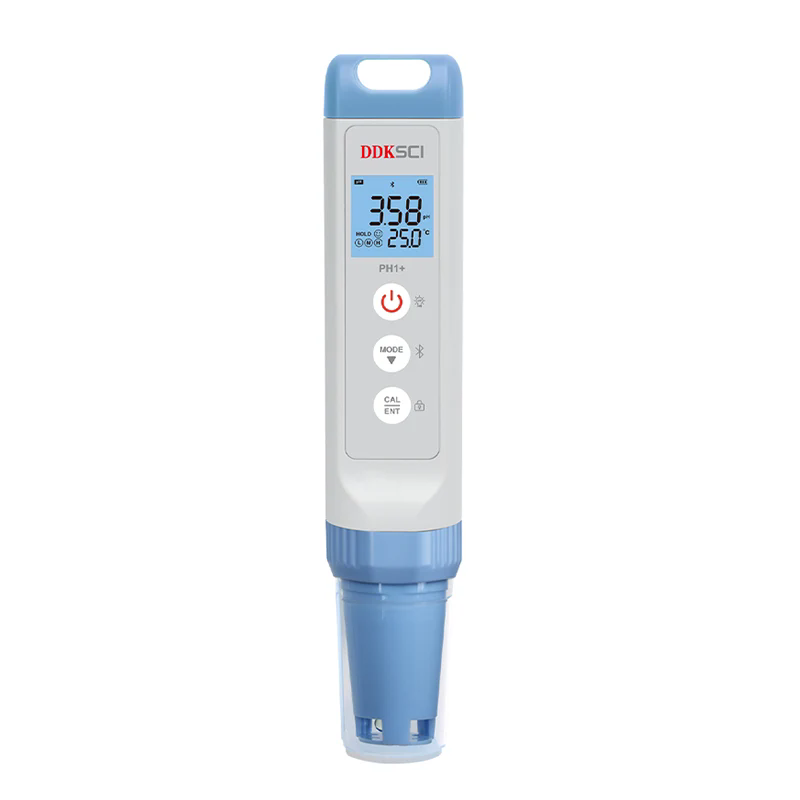
Shanghai DDK Scientific Instruments Co., Ltd. has designed our Pocket Meters to address each of these error sources. Our electrodes use a low-resistance glass membrane that is less susceptible to drift. Our reference junction uses a double-junction design that resists clogging in dirty samples. And our firmware includes an automatic temperature compensation algorithm that adjusts the reading based on the measured temperature.
2. How Does Automatic Temperature Compensation Work in a Pocket Meter?
Automatic temperature compensation (ATC) is essential for achieving ±0.01 pH accuracy in the field. The Pocket Meter measures the temperature of the sample using a built-in thermistor or RTD sensor. The microprocessor then applies a correction to the pH reading based on the Nernst equation. The correction factor is approximately 0.003 pH per degree Celsius per pH unit from the calibration temperature. For example, if the meter is calibrated at 25°C and the sample is at 15°C, the correction for a pH 7.0 sample is 0.003 × 10 × 7 = 0.21 pH. Without ATC, the meter would read 6.79 instead of 7.00. With ATC, the reading is corrected to 7.00 ± 0.01.
The table below shows the effect of temperature compensation on pH accuracy for our Pocket Meters.
| Sample temperature | Uncompensated reading (pH) | With ATC reading (pH) | Error without ATC |
| 5°C | 6.58 | 7.00 | 0.42 pH |
| 15°C | 6.79 | 7.00 | 0.21 pH |
| 25°C (calibration temp) | 7.00 | 7.00 | 0.00 pH |
| 35°C | 7.21 | 7.00 | 0.21 pH |
| 45°C | 7.42 | 7.00 | 0.42 pH |
The ATC system in our Pocket Meters uses a high-accuracy thermistor with a tolerance of ±0.1°C. This ensures that the temperature correction is accurate to within 0.001 pH. The microprocessor updates the reading every 0.5 seconds, so the display tracks temperature changes in real time.
3. What Electrode Design Features Enable ±0.01 pH Accuracy in Harsh Conditions?
The electrode is the heart of any pH measurement system. In a Pocket Meter, the electrode must be rugged enough to survive field use while maintaining the sensitivity required for ±0.01 pH accuracy. There are three key design features. The first is the glass membrane. Our Pocket Meters use a low-resistance glass membrane with a spherical bulb. The low resistance reduces the response time and minimizes drift. The spherical bulb provides a large surface area for contact with the sample, which improves stability. The second feature is the reference junction. We use a double-junction design with a ceramic frit. The inner junction is filled with a gelled electrolyte, and the outer junction is filled with a polymer that resists clogging. The third feature is the body material. Our electrodes are housed in a polycarbonate or epoxy body that resists impact and chemical attack.
The table below summarizes the electrode specifications for our standard Pocket Meters.
| Specification | Value | Benefit for field use |
| Glass membrane resistance | 100 – 150 MΩ | Fast response, low drift |
| Reference junction type | Double junction, ceramic frit | Resists clogging in dirty samples |
| Electrolyte | Gel-filled, KCl | No refilling required |
| Body material | Polycarbonate (standard) or epoxy | Impact resistant, chemical resistant |
| Operating temperature | 0°C to 60°C | Suitable for most field conditions |
| Storage solution | 3M KCl or proprietary storage gel | Maintains hydration layer |
Our factory tests every electrode for slope and offset before it is assembled into a Pocket Meter. The slope must be between 95 and 105 percent of the theoretical value, and the offset must be within ±10 mV. This ensures that the electrode will provide accurate readings across the full pH range.
4. How Should Field Technicians Calibrate and Verify a Pocket Meter?
Calibration is the foundation of accurate pH measurement. Even the most precise Pocket Meter will drift over time. The calibration procedure should be performed at the beginning of each day or before each critical measurement. The procedure uses two or three buffer solutions with known pH values. For ±0.01 accuracy, we recommend using pH 4.01, pH 7.00, and pH 10.01 buffers. The meter should be calibrated in the buffer that is closest to the expected sample pH. For example, if the sample is expected to be pH 5.5, calibrate with pH 4.01 and pH 7.00. If the sample is expected to be pH 8.5, calibrate with pH 7.00 and pH 10.01.
Field verification tip: After calibration, measure a fresh sample of pH 7.00 buffer as an unknown. The reading should be within ±0.01 pH. If it is not, the electrode may need cleaning or replacement. This simple check takes less than a minute and can prevent inaccurate measurements.
Our Pocket Meters include an automatic calibration recognition feature. The meter detects the buffer solution and calibrates automatically. This reduces the risk of human error. The meter also stores the calibration data and displays a reminder when calibration is due. Shanghai DDK Scientific Instruments Co., Ltd. provides a calibration kit with every Pocket Meter that includes fresh buffer solutions, storage solution, and a rinse bottle.
Frequently Asked Questions About Pocket Meter pH Accuracy in Field Conditions
Summary for Field Technicians and Environmental Monitors
Achieving ±0.01 pH accuracy in field conditions requires more than a high-quality electrode. It requires a complete system: a low-resistance glass membrane, a clog-resistant reference junction, accurate temperature compensation, and a rigorous calibration routine. The Pocket Meter is designed to deliver this level of accuracy in a portable, rugged package. When used correctly, it provides reliable data for environmental monitoring, agricultural management, and industrial process control. Shanghai DDK Scientific Instruments Co., Ltd. has been manufacturing Pocket Meters for over 15 years and supplies to field professionals in more than 40 countries.
Shanghai DDK Scientific Instruments Co., Ltd. manufactures Pocket Meters with automatic temperature compensation, double-junction electrodes, and a calibration reminder system. We provide calibration kits and replacement electrodes for all of our models.